Author’s Note: I wrote but never published this review nearly four years ago. I thought about rewriting the whole thing but decided against it. I wanted to preserve my feelings about the game from when I played it back in 2019. The original text is all here except for a few changes I made. So, without further ado, I hope you enjoy my review of Fire Emblem: Three Houses.
p.s. I write about ludonarrative dissonance twice in this review. Knowing me, I probably read an article about it just before writing this review and decided to include it in here. I stand by what I wrote although I do not like using that term because it makes me sound pompous. Also, and let’s be honest, every game has ludonarrative dissonance.
p.s.s. I don’t do review scores anymore but I did when I originally wrote this review. As such, I decided to leave this score in as a fun piece of history. Enjoy!

Better late than never.
Unlike my review of Astral Chain (which I reviewed six hundred years ago), where the final score fluctuated wildly throughout the review process, I was fairly confident in the score I was going to give Fire Emblem: Three Houses. To be honest with you all, I was disappointed with the game especially given its positive critical reception when it released back in July of 2019. I’ve only played three Fire Emblem games in my life and I’ve mostly enjoyed my time with them so I was excited for Three Houses. Unfortunately, I don’t think the game was made for me.
The combat is the best part of Three Houses. In case you didn’t know, the Fire Emblem series is known for its turn-based strategy battles. That heritage continues in Three Houses. There are two different sets of difficulty levels to choose from at the beginning of the game. The first difficulty option deals with how hard the combat is. A little warning for those of you who may be veterans of the franchise; I played the game on Normal difficulty and the combat was very easy. There were a few battles that were a little difficult but my characters never really faced a challenge for the majority of the game. Enemies died after one attack most of the time.
The second difficulty selection is for what mode you want to play the game in; casual or classic. The Fire Emblem series has traditionally made it so once a character dies on the battlefield, then they’re gone for the rest of the game. If you like that system, then classic is the option for you. Casual mode allows for fallen characters to return once a battle is over. These two options are all well and good although I think the addition of the Divine Pulse mechanic makes this whole choice selection obsolete. Like Mila’s Turnwheel in Fire Emblem Echoes: Shadows of Valentia, Divine Pulse allows you to turn back time to a previous turn. So, if you lose a character, you can simply rewind the clock and voilà the character is back. Keep this in mind when choosing your mode.


Character classes are back in Three Houses. Classic classes like archer, knight, paladin, and mage are in the game along with a few new ones. Characters must increase certain skills and master their current class in order to change classes. Characters do not have to meet every requirement in order to change classes, however. There’s a percentage meter which shows the likelihood of success so a character could change classes before being fully prepared. I have to say that I liked the class versatility in Three Houses. In past games, a character would change into a class and then they would be stuck using the weapons and moves of that class. In Three Houses, a character can learn multiple skills and weapons even if their class doesn’t traditionally use them. An example is a white mage mastering the bow alongside white magic.

There are four major changes with the combat in Three Houses compared with past titles in the series; battalions, Divine Beasts, combat arts, and no weapon triangle (Shadows of Valentia also didn’t have the weapon triangle). Battalions are groups you can hire that can be attached to a particular unit. These battalions have special abilities and can attack instead of the unit they are attached to. When used, enemy units can’t counterattack and the attack can sometimes stun an enemy and prohibit them from moving on the next turn.
Battalions are particularly useful when fighting beasts. Beasts are animals which take up several tiles on the battlefield and have multiple health bars along with armor. These beasts are particularly hard to take down at the beginning of the game. They added a new element to the combat that I personally haven’t seen before in a Fire Emblem game and I thought they were a great addition to the game.
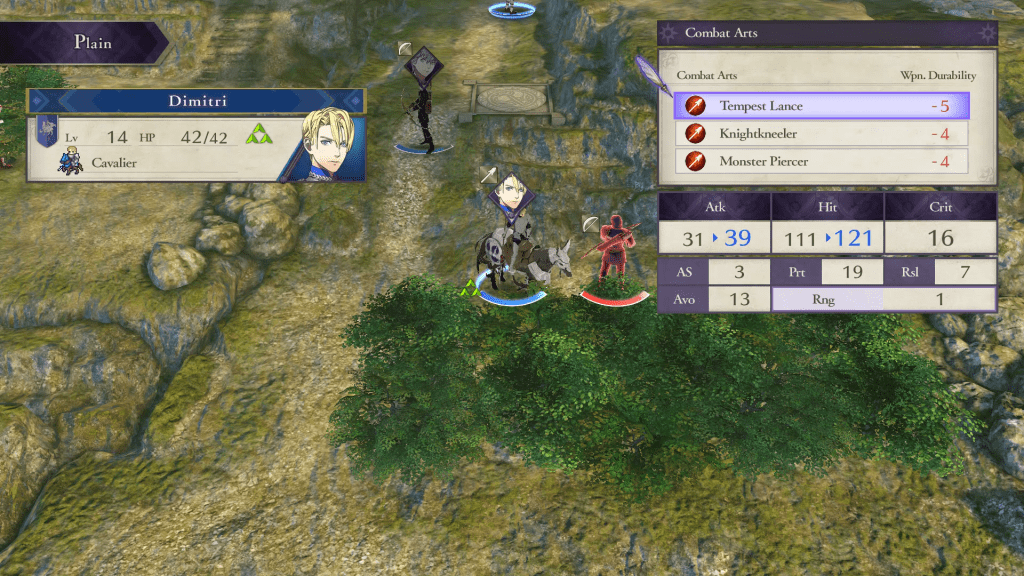
Combat arts are skills that can be learned whenever a character increases their proficiency with a particular weapon. These skills are usually stronger attacks which decrease a weapon’s durability at a faster rate than a normal attack would. They are very useful in situations where you need to deal just a little more damage in order to finish off an enemy.
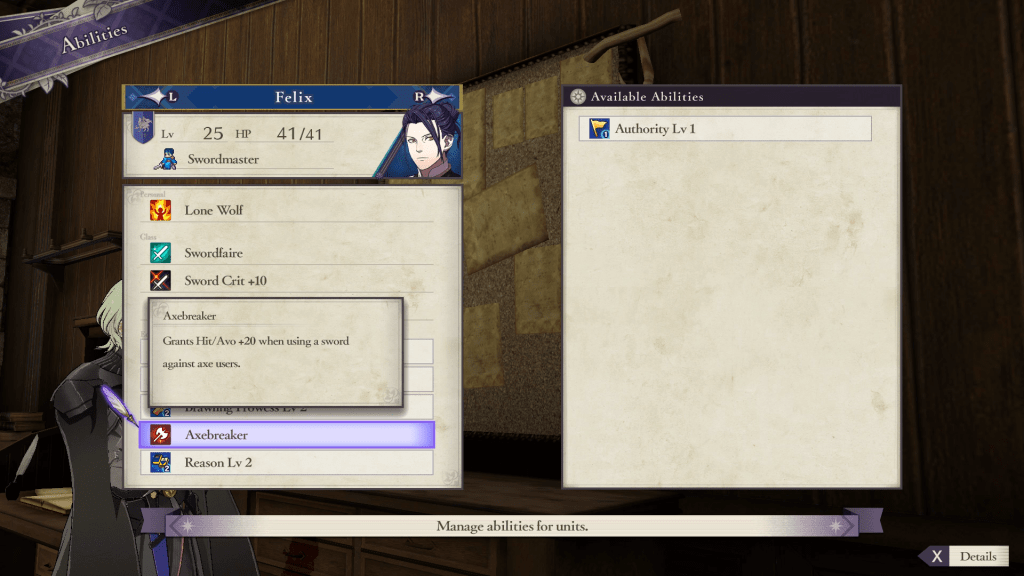
As I said, there is no weapon triangle in Three Houses. I know a few fans will be disappointed to hear that but I didn’t miss it. It never added anything to the combat for me. That being said, however, characters can learn abilities which essentially bring the weapon triangle back into the game. Even though it isn’t officially in the game, it still kind of is.

My favorite part of any Fire Emblem game is the story (I loved Shadows of Valentia’s narrative) which is why I was all the more disappointed with Three Houses. In short, I didn’t like the story at all. Sure, it had its moments but it was, to put it bluntly, bad. You play as a mercenary (you can pick male or female) who is offered a teaching position at Garreg Mach monastery which is the seat of the Church of Seiros, the main religion on the continent of Fόdlan. While there, you can choose to teach one of three houses (imagine that). I chose the Blue Lions for my playthrough because it seemed like no one else in the world had chosen them.
This is all well and good but the problem is that the game never really answers any of the main mysteries of the story. Who exactly is Rhea, the Archbishop of the Church of Seiros? Who is Seteth? Flayn? The Death Knight? What is the central conflict really about? Who are the main antagonists? After putting in over fifty hours into the game and having beaten it, I can’t tell you the answers to those questions. Maybe my questions would be answered if I completed the game while playing as the other two houses. Who knows? What I do know is that I’m not going to spend another 50+ hours at least two more times to find out. It’s a story that has a lot of questions and very few answers. It was very unsatisfying and, even as I’m writing this review, I’m not sure what to make of it.


The story isn’t helped by the fact that you play as a silent protagonist (seems to be a theme lately) and that many dialogue choices in the story don’t matter. Once again, just like with Astral Chain and its player character, there are a few emotional moments in the story that are brought down by a protagonist who can only experience them in silence. What makes matters worse is that the main character actually has a voice whenever he/she gains a level in combat. Why couldn’t the person who voiced those lines be used in the story as well? It really baffles me.
As for the dialogue choices, there are a few moments when you’re given a choice as to what to say. No matter what you pick (and I tried this a few times) the end result is the same. Why even make a choice available if it doesn’t carry any weight? There are even a few times where a dialogue choice pops up but there’s only one option. Again, why even have it available if there is only one choice? The dialogue design in Three Houses was really strange to me.
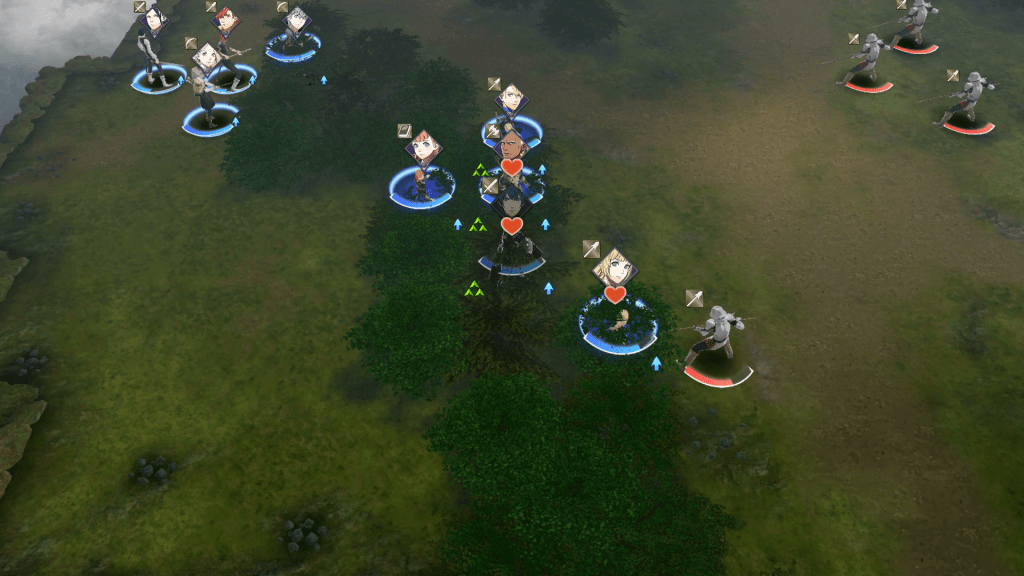
Even though I didn’t like the story at all, there was one saving grace; the characters. You will get to know the members of your class very well during the course of your adventure. This mostly happens through support conversations. These conversations are unlocked by placing characters next to each other on the battlefield. These conversations were always fun since I never knew what I was going to get. Some were funny, others serious, and a few even reveal important story information. I don’t know why some of these story beats weren’t included in, you know, the actual story but I digress. The developers obviously put a lot of work into these conversations since every character could conceivably have a conversation with any other character in the game. This is because you can recruit characters of other houses to your own house. Although these interactions did endear me to the characters, I will say that the characters weren’t as good as the ones found in past Fire Emblem games.


Although I enjoyed the support conversations, there was one glaring issue with them; ludonarrative dissonance. For those of you who don’t know, ludonarrative dissonance, as I understand it, occurs when the story doesn’t exactly match up with the gameplay. A minor spoiler is incoming so prepare yourself. There is a five-year time skip in the middle of the game and a few character’s support conversations don’t reflect that. The characters will simply pick up where they left off as if those five years didn’t happen. Ludonarrative dissonance usually doesn’t bother me but, in this instance, it was very noticeable.
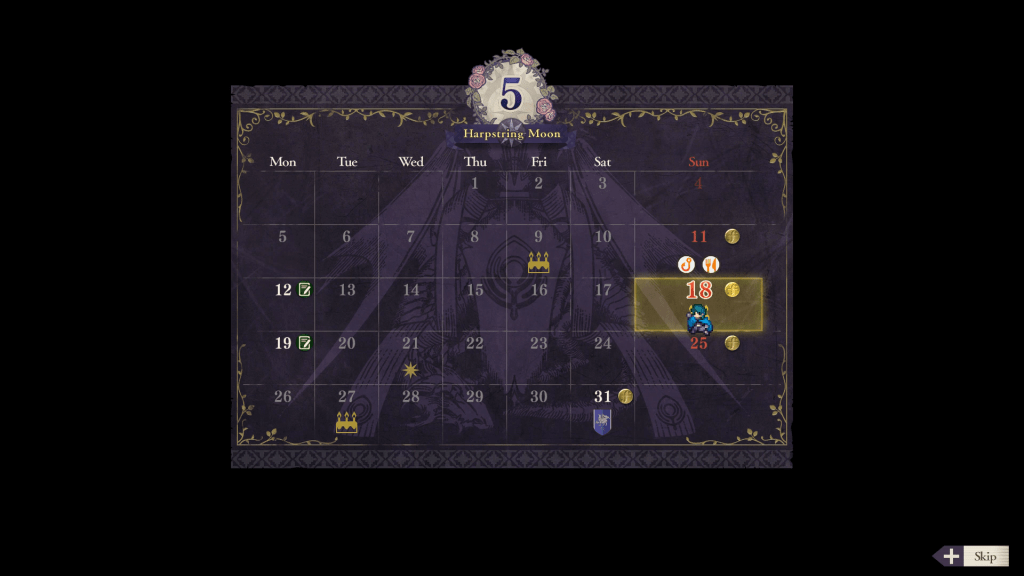
And now we come to the biggest issue, in my mind at least, with the game. Since you are a professor, the year is divided up into twelve months. Each month is divided up into weeks, of course. Each month has a main mission which always conveniently falls at the end of the month. Each week, you have the opportunity to train your students in class. You can choose to do this manually or have the game do it automatically. Your ability to train students is dependent on their motivation.
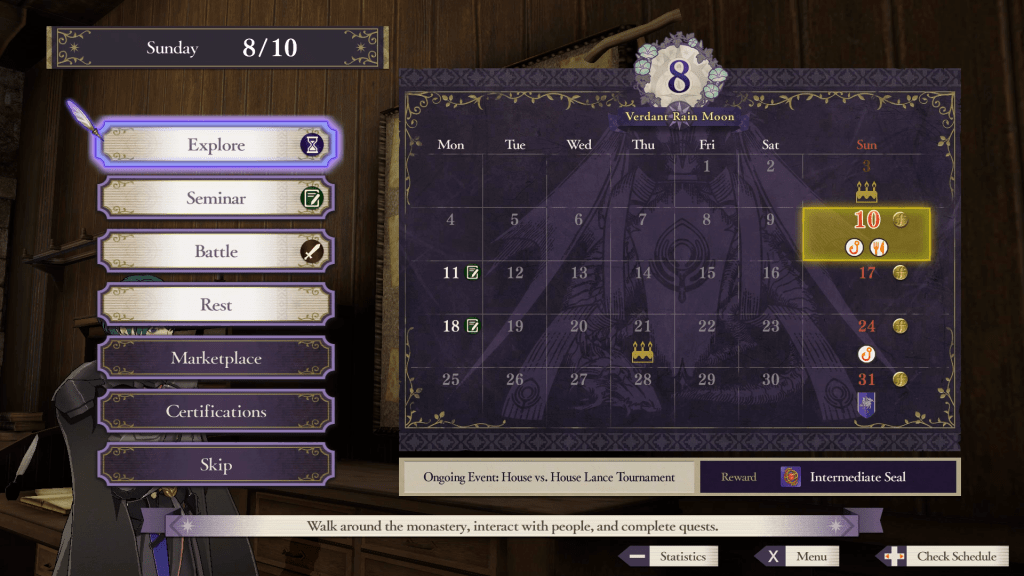
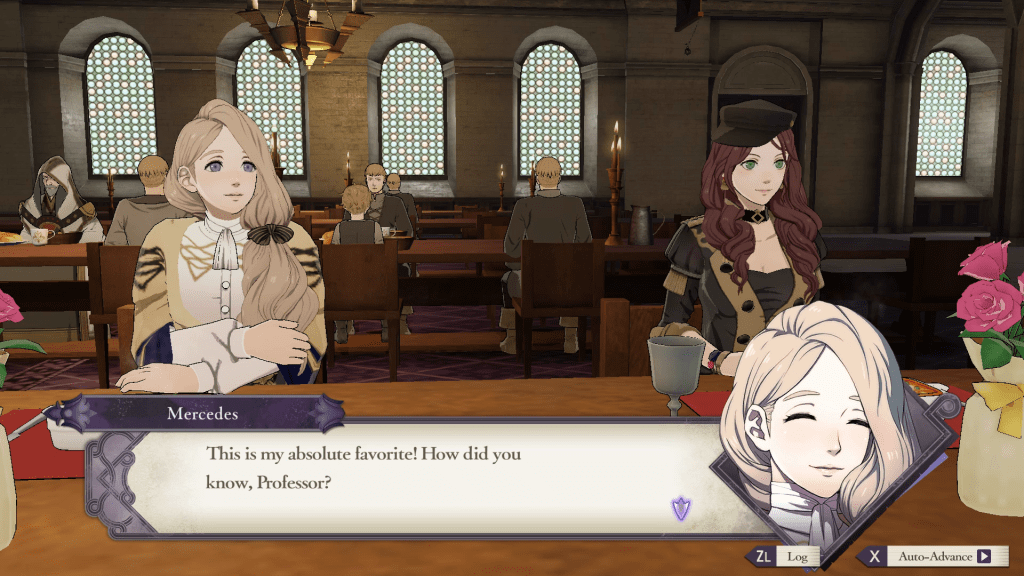
Motivation can be increased in a variety of ways; through rest (more on that in a bit), eating at the dining hall with your students, or by a character obtaining the MVP award in battle. Eating in the dining hall and resting is possible because there is a so-called free day at the end of each week. On these days, you get to choose what your class does. You can battle (which sometimes includes Paralogue Battles which are battles that are pertinent to certain characters), rest to restore motivation (among other things), or explore the monastery.
Exploring the monastery was interesting at first since there always seemed to be new areas to explore and quests and a ton of activities to do. As the game progresses, however, it becomes apparent that there really isn’t much variety to the activities at the monastery. You can fish, eat at the dining hall (as I said before), or host tea parties just to name a few. You can also talk to people although these aren’t the most interesting of conversations, return lost items to people at the monastery, and recruit other students to your house. This may all sound like fun but talk to me again after you do twelve in-game months of it followed by twelve more months of it after the time skip. There were times when I simply burned through free time by resting because I was bored.


Not only did it become boring but the calendar is the biggest source of ludonarrative dissonance (noticing it two times in one game is a new record for me). As I said, the calendar system continues after the time jump. There are moments in the story when your army is on the move but you still have to train your students or choose what to do during free time back at the monastery. How can your army be moving yet still be at the monastery to hold classes? In case you couldn’t tell, I was not a fan of this new system in Three Houses. My biggest worry is that this will continue in future games in the series. I sure hope it doesn’t.
Before we go, I want to end on a positive note since all I’ve been doing is hating on the game. My favorite part of the game was the soundtrack. If you couldn’t tell, I’m a big fan of video game soundtracks and Fire Emblem: Three Houses has a very good one. I recommend you at least give it a listen if you have the chance.
In Conclusion:
Fire Emblem: Three Houses is a disappointment in my eyes. If you can recall, Three Houses was included in my list of Games to Look Forward to in 2019. That is why it hurts so much to say that I didn’t enjoy my time with the game. I enjoyed parts of it, sure, but not most of it. The combat, class versatility, characters, and soundtrack were all good but these positives were brought down by the bad story, calendar structure, and two glaring instances of ludonarrative dissonance. I know this puts me in the minority of gamers but this is how I honestly feel about the game. Consequently, I look forward to your hate mail!
Final Score: 6/10
Pros:
- Combat
- Class Versatility
- Characters
- Soundtrack
Cons:
- Story
- Monthly calendar
- Ludonarrative dissonance
Thanks for reading!

 The Pretend Gamer